The Persistent Challenge of Static Credentials in Windows
Despite modern security tools, many organizations still depend on static credentials to access Windows servers and workstations. These credentials—shared local admin accounts, long-lived domain accounts, unrotated service accounts, and manually provisioned privileged logins—often remain valid for months or even years because rotation is cumbersome or ignored. This lack of automation creates a fertile ground for credential theft and lateral movement. Even when multi-factor authentication (MFA) or directory services are in place, the underlying static passwords are reused across sessions, leaving a gaping security hole. In Windows environments, RDP access, troubleshooting, and break-glass scenarios frequently rely on such shared accounts, increasing exposure risks for CISO, DevOps, and security teams.
The Broad Access Problem with Traditional VPNs
To improve security, many organizations adopt a castle-and-moat approach using VPNs. While VPNs encrypt network traffic, they grant overly broad access—users connect to the entire network, not just specific resources. Controlling lateral movement then requires complex firewall rules, security groups, and network segmentation, all tied to IP addresses rather than user identity. This method is brittle, especially in dynamic cloud environments where IPs change frequently. Deploying additional tools to fine-tune access leads to operational sprawl and complexity. Traditional VPNs solve connectivity but fail to enforce user-to-resource access control, leaving organizations vulnerable to internal threats.
A Modern Solution: Identity-Based Access and Dynamic Credential Management with Boundary and Vault
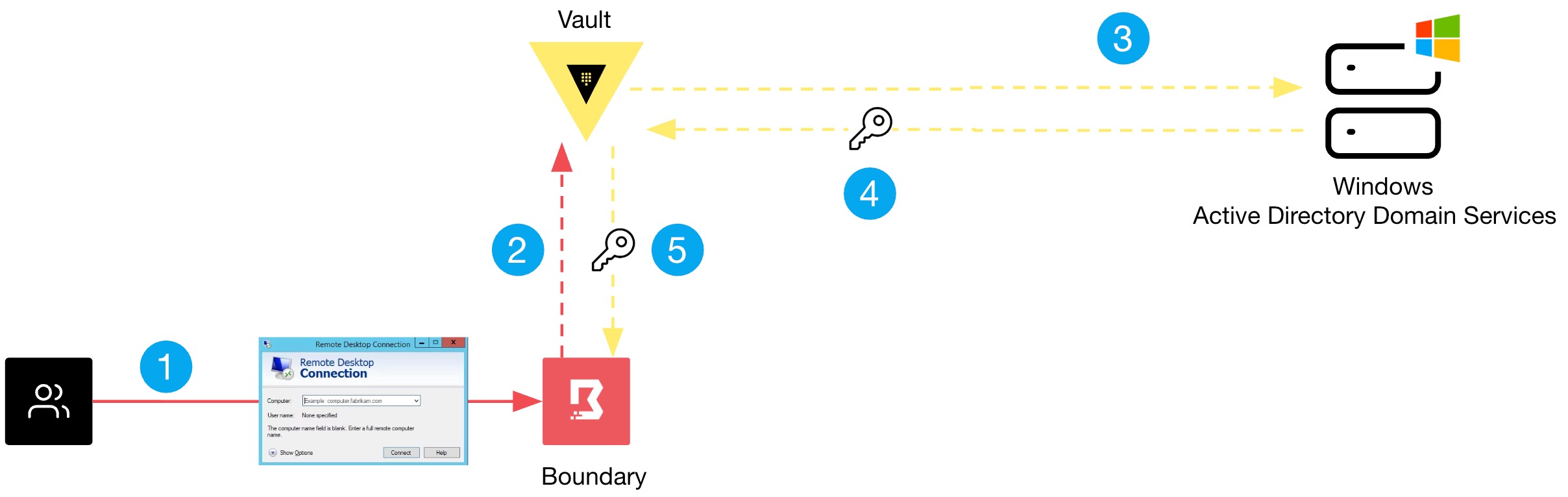
IBM Boundary transforms the access model by combining authentication and authorization into a single platform. Instead of granting broad network access, Boundary creates direct, ephemeral connections between a verified user and a specific resource based on identity. This eliminates the need for VPNs and reduces lateral movement risks. Static credentials are replaced by dynamic credentials managed by HashiCorp Vault, which brokers secrets on behalf of users. When a user requests access to a Windows server, Boundary dynamically fetches a temporary credential from Vault, injects it into the session, and revokes it upon logout. This ensures that no long-lived password exists to be stolen.
How Boundary Works
Boundary acts as a proxy between users and targets. After authentication (via OIDC, LDAP, or built-in methods), the user selects a target—e.g., a Windows machine. Boundary negotiates a session, using Vault to generate a one-time credential (like an RDP password). The user never sees the credential; it is automatically used to establish the connection. Session recording and audit logs provide full visibility. This approach scales across on-premises, cloud, or hybrid Windows environments without IP-based rules.
Integrating Vault for Credential Brokering
Vault’s dynamic secrets engine for Windows (e.g., Active Directory or local user) creates unique passwords per session with controlled time-to-live. Combined with Boundary, you eliminate manual rotation and shared accounts. Configuration steps include setting up Vault’s secrets engine, creating a credential store in Boundary, and defining policies that map users to targets. This integration ensures that every access request is unique, audited, and time-limited—drastically reducing credential exposure.
Implementation Considerations
To test this solution, start by deploying Boundary and Vault in a lab Windows environment. Configure Vault’s Active Directory secret engine to generate dynamic credentials for domain accounts. Then set up Boundary with a credential store pointing to Vault. Define targets for Windows machines and create roles granting access to specific users. Use Boundary’s session recording to verify that credentials are injected automatically and revoked after disconnect. This approach not only mitigates static credential risks but also solves broad VPN access by replacing network-level access with identity-based, just-in-time permissions.
In summary, combining Boundary and Vault moves Windows security from a credential-storing, network-wide model to a zero-trust, identity-driven architecture. Organizations can finally retire shared admin accounts, reduce lateral movement, and achieve compliance with least-privilege principles.